How to Spot Signs of Hidden Brake and Suspension Problems in a Used Car in Forney, TX
A used car can look clean and still have worn brakes, loose suspension parts, or tire wear that points to a handling problem. The most useful clues are an unusually soft brake pedal, pulling during stops, repeated vibration, clunks over ordinary bumps, and uneven tire wear. None identifies a failed part by itself, but each gives you something specific to investigate before buying or putting more miles on a recent purchase.
These checks help screen a vehicle, not establish that it is safe to drive. Braking or steering concerns need a hands-on professional assessment of that particular car. At Gregg Automotive in Forney, we offer brake and suspension repairs.
1. Check the repair history and dashboard before driving
“New brakes” can mean several things. It might describe pads on one axle, pads and rotors on all four wheels, or another repair entirely. Receipts are more useful when they identify the work performed, the affected wheels, and the mileage.
Useful questions include:
- Were the brake pads replaced by themselves, or were the rotors also serviced?
- Have any shocks, struts, steering parts, or suspension joints been replaced?
- Why were the tires replaced, and was uneven wear involved?
- Did a vibration, pull, or noise continue after the last repair?
Watch the dashboard during startup. Warning-light checks vary by vehicle, so the owner’s manual helps explain normal operation. A brake warning light that remains on after the parking brake is released deserves attention. ABS and stability-control warnings also belong in the inspection notes, even if ordinary braking seems normal.
2. Read the tires and compare the car’s stance
Tires can reveal a problem that a short test drive misses. With the car parked on level ground, compare the tread across each tire and between wheels. Turned front wheels can make the inner tread easier to see without reaching underneath.
- Wear concentrated on one edge: Alignment, worn components, or both may be involved.
- Repeated high and low patches around the tread: Often called cupping, this can involve tire balance, wheel issues, or suspension wear.
- Both shoulders worn more than the center: Tire inflation history may be a factor.
- One tire noticeably different from the others: Its replacement history may help explain the mismatch.
Compare the space above the tires and look for a corner sitting noticeably lower. Uneven ground or cargo can affect the stance, so appearance alone does not prove a spring problem. Likewise, fresh tires remove some visible wear history but do not prove the underlying cause was corrected.
3. Look for visible wear and leaks without lifting the car
A ground-level inspection with a flashlight can reveal useful clues. Keep it to areas visible from outside the vehicle, with the brakes cool, rather than crawling underneath or reaching behind wheels.
Through an open wheel design, part of the brake rotor and an outer brake pad may be visible. Deep grooves or heavy, flaky corrosion deserve closer inspection. A light orange film after rain or sitting is different from substantial corrosion and does not, by itself, establish that the brakes need replacement.
Visible pad material is only part of the picture. The inner pad can wear differently, and some rear brakes are enclosed in drums.
For suspension components, look for wet streaks or dripping around accessible shocks or struts. These parts control continued bouncing after a bump. A light oily film is not automatically the same as an active leak; appearance needs to be considered alongside how the vehicle behaves.
4. Notice pedal feel before the car moves
With the vehicle stationary and its normal braking assistance active, pay attention to how the pedal responds to steady pressure. Brake feel varies between models, particularly hybrids and vehicles with electronically controlled braking, but it generally needs to feel consistent rather than unpredictable.
Important warning signs include:
- A pedal that feels unusually soft or spongy.
- A pedal that keeps sinking under steady pressure.
- Excessive travel before the brakes respond.
- An unusually hard pedal paired with poor braking response.
These symptoms do not identify a single repair. Air in the hydraulic system, a fluid leak, an assistance problem, or another fault can affect pedal feel. A pedal that approaches the floor or cannot hold the car stationary is a reason to skip the road test, not try a harder stop.
5. Check ordinary stops for pulling
If the stationary checks reveal no braking or steering concerns, a low-traffic route allows observation during a few ordinary, low-speed stops. There is no need for emergency-braking maneuvers or repeated hard stops.
Keep both hands on the wheel and notice whether the car changes direction when the brakes are applied. A pull that appears specifically during braking can involve uneven braking force, but tires and suspension can also contribute.
Compare that behavior with steady-speed driving. A car that drifts all the time presents a different clue from one that tracks straight until you press the pedal. Road slope, wind, and tire pressure can influence the result, so one moment of drift is not a diagnosis.
A strong pull, poor stopping response, or difficulty maintaining control is a reason to end the test drive.
6. Separate braking vibration from road-speed vibration
When vibration happens is often more useful than simply reporting that the car “shakes.” Note whether it appears through the steering wheel, brake pedal, seat, or more than one place.
Vibration mainly while braking
Repeated pedal pulsation or steering-wheel shake during ordinary stops can involve uneven brake-rotor thickness or an uneven friction surface. Calling every case “warped rotors” skips the measurements needed to identify the cause. Worn suspension or steering parts can also contribute to shaking under braking.
Vibration at a particular speed, even without braking
This pattern points toward a broader check of tires, wheels, and related components rather than brakes alone. A wheel imbalance, tire irregularity, or wheel damage can produce speed-related vibration.
For example, “the steering wheel shakes during gentle braking but stays smooth at the same speed without braking” is a much more useful inspection note than “the front end feels bad.”
7. Listen during normal turns and small bumps
Turn down the audio and listen as the car crosses ordinary pavement joints or makes normal low-speed turns. Deliberately hitting potholes adds risk without providing a better inspection.
A clunk over a small bump can come from several places, including a suspension joint, mount, or sway-bar link. Sway-bar links connect parts that help control body lean. Rubber bushings, which cushion and support suspension connections, can also wear and allow unwanted movement.
Not every noise is a suspension problem. Clicking during a turn can involve a drive axle, while rattling may come from loose exhaust parts or something in the cargo area.
Brake noises also need context. A brief squeak after damp weather differs from persistent grinding during stops. Recurring grinding is a reason to stop the drive and have the brakes evaluated rather than testing whether the sound clears.
8. Watch how the suspension settles and the steering responds
Over a gentle road undulation, the body can move and then settle. Continued bouncing, a floating sensation, or repeated side-to-side movement can suggest that the suspension is not controlling movement well.
Some forward body movement during braking is normal. The concern is excessive or poorly controlled movement, especially when it accompanies noises, uneven tire wear, or unstable handling.
During ordinary driving, note whether the steering responds consistently or requires frequent corrections. An off-center steering wheel can indicate an alignment concern, but alignment alone will not repair a loose joint or worn bushing.
A parked “bounce test,” pressing down on a corner of the car, cannot clear the suspension. It does not reliably expose every worn damper, loose connection, or handling problem that appears under driving loads.
9. Understand what a professional inspection adds
A buyer’s check identifies symptoms. A professional inspection can connect those symptoms to measured wear, component condition, and the vehicle’s design.
Brake checks beyond a look through the wheel
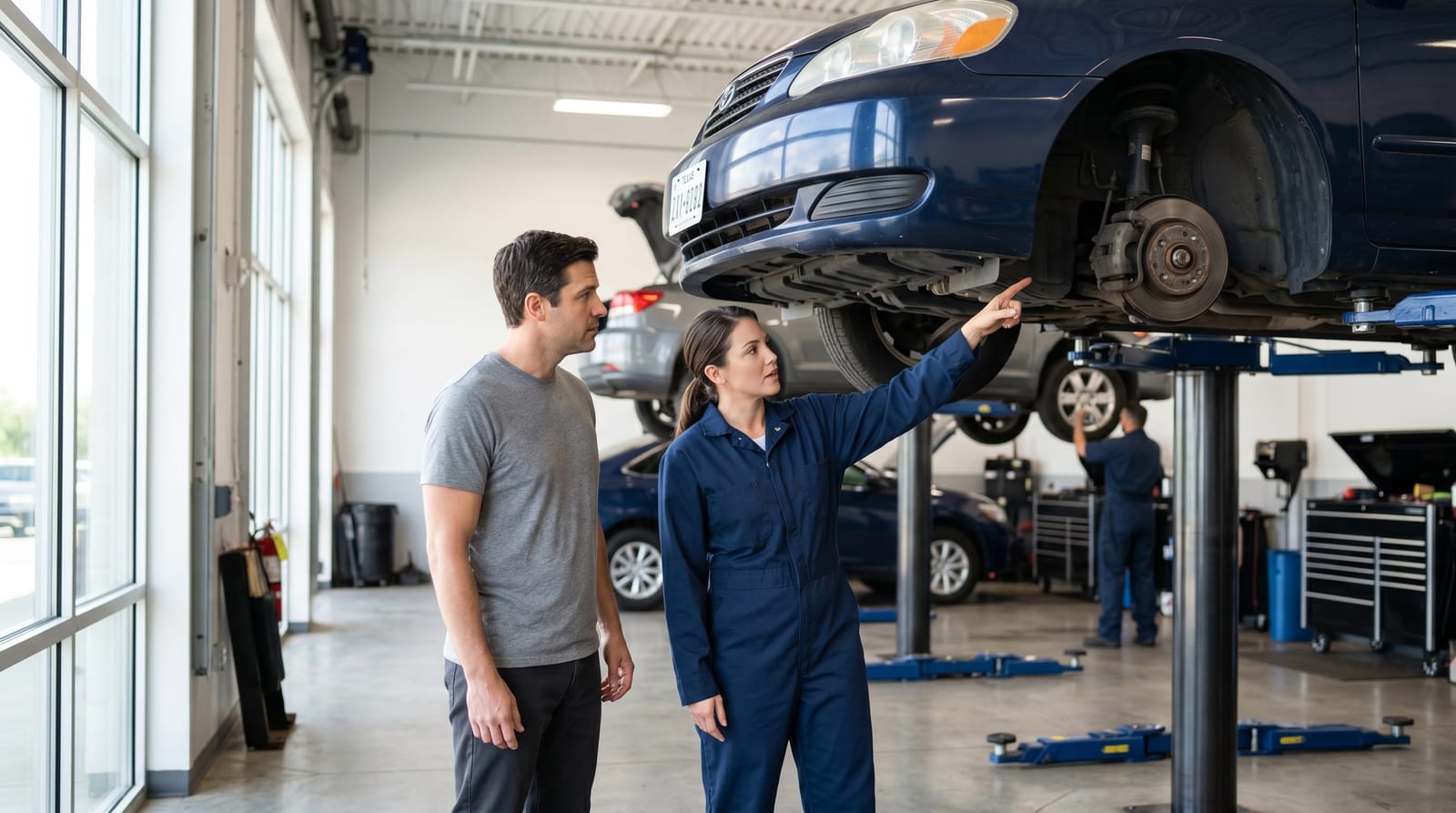
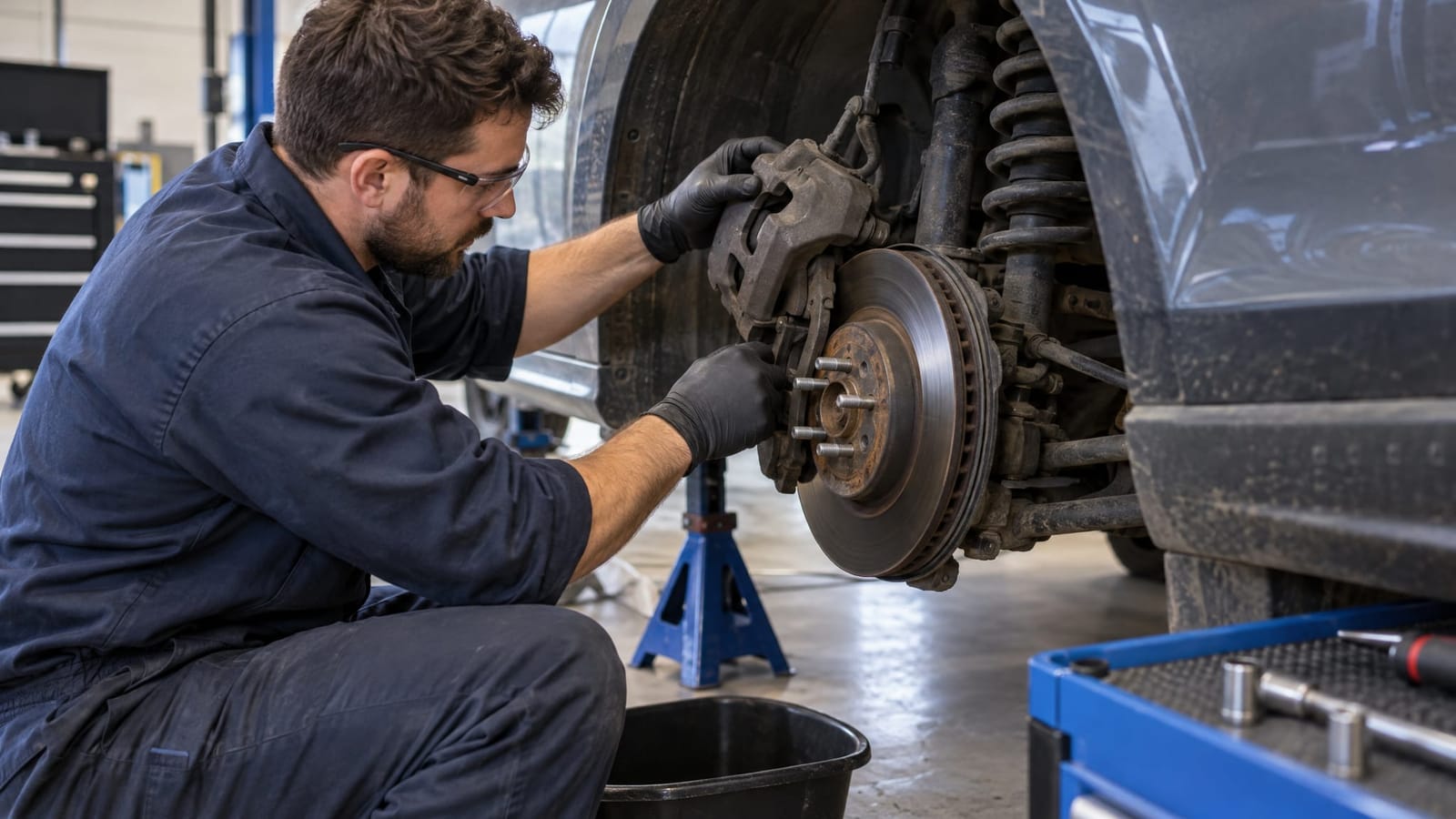
Removing the wheels allows closer examination of inner and outer pads, rotors, calipers, hoses, and other accessible components. Measurements help establish remaining friction material and whether a rotor is within its service limits. Uneven pad wear can also point toward a sticking or binding component rather than ordinary wear alone.
Suspension checks beyond the test drive
With the vehicle supported appropriately, inspection can check for unwanted movement in steering joints, suspension joints, and wheel bearings. Bushings, mounts, springs, shocks, and struts can be examined more closely. Different suspension designs require different checking methods, which is one reason a driveway glance has limits.
A useful report separates measured findings from symptoms that need further diagnosis. It also distinguishes current repair needs from wear worth monitoring. For the inspection itself, our explanation of used car brake inspection costs in Kaufman County covers what to expect when comparing inspection scope.
Use the findings to make a clearer ownership decision
Before buying, the useful question is not simply whether the car has a noise. It is whether the cause has been identified and the necessary work described. A promise to “fix the alignment” does not address a worn suspension joint, just as new brake pads do not explain away a sinking pedal.
For a recent purchase, inspection findings create a maintenance baseline. Keep the report with repair receipts and note the conditions behind any unresolved symptoms. Specific observations and measured findings make it easier to separate routine wear from a problem that needs attention before further driving.