First 1,000 Miles in a Used Car: The Maintenance Checklist for Kaufman County TX Owners

After buying a used car, start with its maintenance records, oil-change history, brakes, tires, fluid levels, and battery condition. Address safety concerns and active symptoms first, then compare routine maintenance with the manufacturer’s schedule. The goal is a dependable starting point, not an automatic replacement of every part or a flush of every fluid.
For drivers in Forney and across Kaufman County, the first 1,000 miles provide a useful window for noticing patterns during everyday driving. This is an observation period, not a manufacturer-recommended service interval. Existing problems and overdue maintenance deserve attention before that window ends.
1. Gather the records before approving a maintenance package
Start with the owner’s manual, service receipts, current odometer reading, and maintenance information from the seller. Match each documented service to both its date and mileage, since maintenance can become due by either measure.
A reset maintenance reminder is not proof of completed work. An itemized receipt is more useful because it identifies what was serviced and when.
- Record the date and mileage of the last documented oil change.
- Look for brake, tire, battery, spark plug, and fluid-service records.
- Compare completed work with the manufacturer’s maintenance schedule.
- List gaps in the records separately from services that are clearly overdue.
Missing paperwork does not automatically mean the car was neglected. Our explanation of what deferred maintenance means on a used car in Forney helps distinguish overdue work from incomplete records.
2. Establish an oil and filter baseline
If there is no reliable record of the last oil change, an oil and filter change is a practical starting point. If a receipt documents recent service using the correct oil, another immediate change may add little value.
The important details are the oil specification, service date, mileage, and current oil level. Oil color alone is not a reliable way to decide whether a change is due.
For example, an oil-change sticker provides less detail than an invoice listing the oil used and the odometer reading. Even with a recent receipt, checking the current level remains part of the baseline.
Follow the owner’s manual for oil specifications, level-checking procedures, and future intervals. Our guide to getting an oil change after buying a used car near Kaufman explains when an immediate change makes sense and when documented service can carry forward.
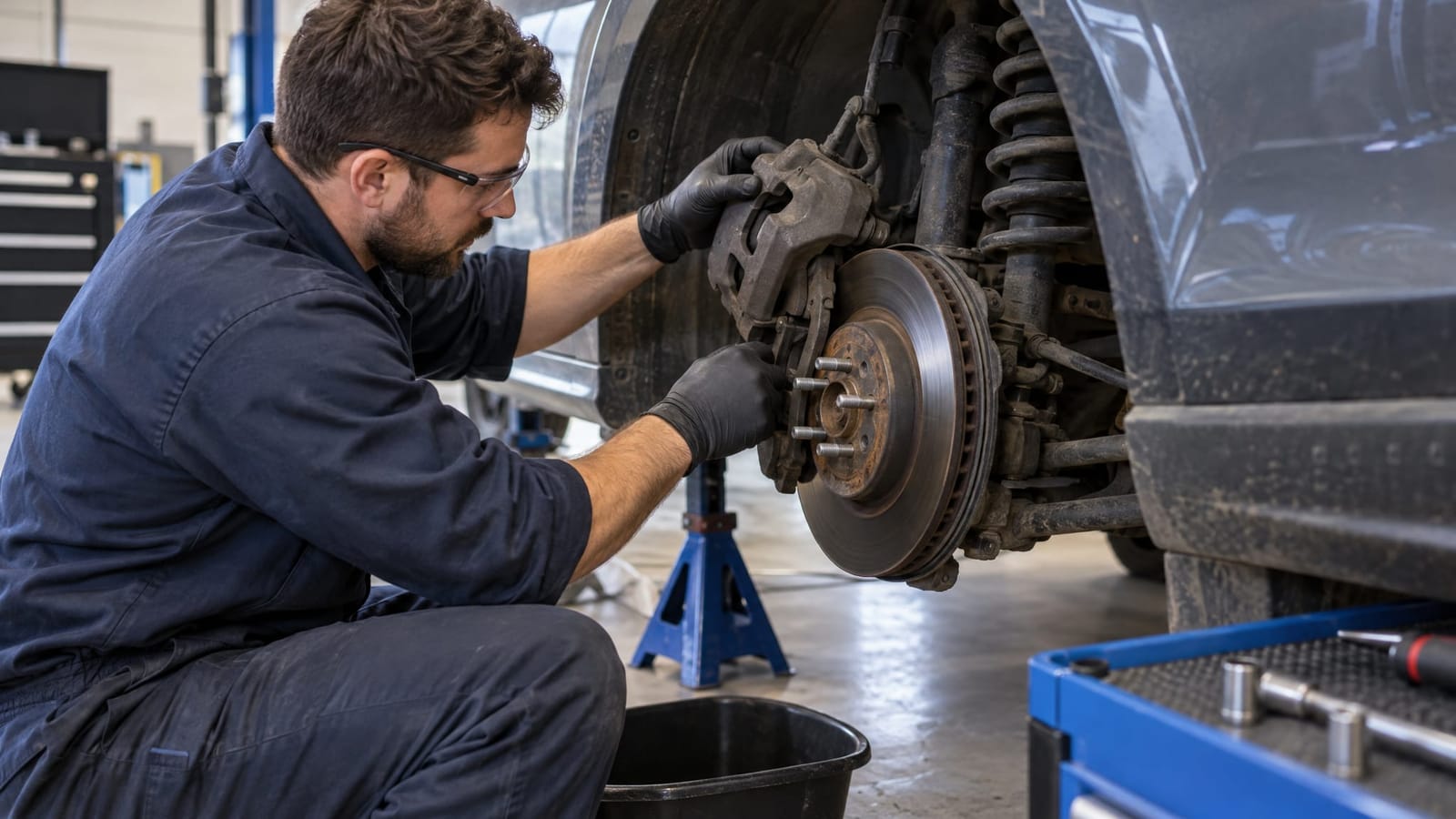
3. Check the brakes beyond how they sound
Quiet brakes do not necessarily have plenty of service life remaining. A useful inspection considers pad or shoe wear, rotor or drum condition, hoses, leaks, and how the system operates.
Note anything unusual during normal driving:
- A pedal that feels soft, sinks, or requires noticeably different effort.
- Grinding, repeated squealing, or vibration while braking.
- Pulling to one side when slowing down.
- A brake warning light that remains illuminated.
These observations help describe the concern, but they do not identify the repair by themselves. Braking vibration, for example, needs evaluation rather than an automatic parts replacement.
If braking or steering feels unsafe, towing the vehicle for an in-person assessment is safer than continuing to drive. At Gregg Automotive in Forney, we handle brake and suspension repairs.
4. Inspect tire condition, pressure, and wear patterns
Check more than whether the tires hold air. Look across the tread width and at the visible sidewalls for uneven wear, cuts, bulges, or exposed cords.
Set cold tire pressure according to the vehicle’s tire-information placard, commonly found in the driver’s door area. The maximum pressure molded into a tire’s sidewall is not the vehicle’s recommended setting.
Uneven wear can point toward an inflation, alignment, or suspension issue. Replacing a worn tire without addressing the cause can leave the underlying problem in place.
Check that tire sizes match the vehicle’s requirements. Some vehicles use different front and rear sizes, which affects rotation options. If the vehicle has a spare, include its condition and pressure in the baseline check. Locate the jack and wheel-lock key, if equipped, too.
5. Separate fluid checks from fluid replacements
An initial fluid review can include engine oil, coolant, brake fluid, transmission fluid, washer fluid, and hydraulic power-steering fluid where fitted. Not every vehicle has an accessible dipstick or the same checking procedure.
Low fluid needs an explanation
Adding fluid can restore a level without resolving why it dropped. Low coolant may accompany a leak. A low brake-fluid level can relate to brake wear or leakage, so topping it off is not a substitute for checking the system.
Check coolant at the reservoir with the engine cold, following the manual. Use the specified fluid, since products with similar names are not always interchangeable.
A fluid change and a flush are different services
A drain-and-fill replaces fluid through the system’s drain and refill procedure and may leave some old fluid behind. A service described as a flush can involve a fluid exchange or a cleaning process, depending on the system and equipment.
Neither belongs on every used car’s immediate checklist. The decision depends on the manufacturer’s requirements, service history, system condition, and symptoms. Ask which procedure is proposed and what finding supports it. A shifting problem, for instance, needs diagnosis rather than a promise that a transmission flush will fix it.
6. Check the engine and cabin air filters separately
These filters serve different purposes. The engine air filter keeps debris out of the engine’s intake air. The cabin filter, where fitted, filters air entering the passenger compartment through the ventilation system.
Inspect the engine filter for excessive debris, damage, and a proper fit in its housing. Check the cabin filter if airflow seems weak or there is no replacement record.
A dirty cabin filter can restrict airflow, but it does not explain every air-conditioning problem. Strong airflow that never gets cold is a different concern from weak airflow through every vent.
Replace filters based on their condition and the maintenance schedule, not simply because the vehicle has a new owner.
7. Test the battery rather than relying on one successful start
A normal start at pickup tells you the battery started the car that time. A battery test gives a better picture of its current starting capability, though it cannot predict exactly how long the battery will last.
Include the battery connections and mounting hardware in the check. Loose connections or corrosion can contribute to starting trouble, while a poorly secured battery needs attention.
Record slow cranking, intermittent no-starts, or a charging-system warning light. Those symptoms may involve the battery, connections, starter, charging system, or another electrical issue.
The useful distinction is testing versus guessing. Replacing a battery without investigating a charging problem can leave the original concern unresolved.
8. Review belts, hoses, leaks, and timing-service history
A visual inspection can reveal frayed accessory belts, deteriorated hoses, loose connections, or fluid residue. Fresh spots where the car parks are also worth documenting with a photo and their location beneath the vehicle.
Clear water after air-conditioning use can be normal condensation. Oily residue, colored fluid, or a repeated drop in a reservoir level deserves closer evaluation. Color alone is not a reliable way to identify a leak.
Also check whether the engine uses a timing belt with a scheduled replacement interval. The accessory belt that drives components such as the alternator is a separate item. Inspecting it does not tell you when the timing belt was last replaced.
If timing-belt replacement is part of the manufacturer’s schedule, compare the records with the vehicle’s age and mileage. Keep it as a separate item on the maintenance list.
9. Decide whether a tuneup is actually due
“Tuneup” can describe different work on different vehicles. Identify the specific maintenance item, such as scheduled spark plug replacement, rather than approving a package based only on that label.
Compare the service history with the manufacturer’s schedule. A vehicle with documented, current spark plug service does not automatically need another set because it changed owners.
Rough idling, hesitation, and a check-engine light call for diagnosis rather than an assumption that worn plugs are responsible. A diagnostic code helps direct testing; it is not, by itself, an instruction to replace a particular part.
Our guide to whether a used car needs a tuneup immediately after purchase explains the difference between scheduled maintenance and symptom-driven repairs.
10. Test air conditioning, visibility, and everyday controls
Work through the controls while the car is parked. Small usability problems are easier to document before they become part of the daily routine.
- Test headlights, turn signals, and hazard lights. A helper can check the brake lights.
- Check wiper operation, blade condition, and washer spray.
- Try the defroster and ventilation settings.
- Check windows, mirrors, locks, and seat adjustments.
For an air-conditioning complaint, record whether the issue is weak airflow, warm air, unusual noise, or intermittent cooling. During normal trips, note whether cooling changes between idle and driving. Those distinctions help narrow the evaluation. We also service air conditioning systems.
11. Keep a short symptom log during the first 1,000 miles
The most useful ownership notes describe when something happens, not just what it sounds like. “Rattle over bumps at low speed” gives more direction than “car makes noise.”
Record the mileage and conditions when a symptom appears:
- Cold startup or after the engine warms up.
- Braking, turning, accelerating, or steady-speed driving.
- Air conditioning on or off.
- A one-time event or a repeatable pattern.
Recheck oil and accessible fluid levels using the manual’s procedures, and note any changes. Photograph dashboard messages when parked. A new warning light or worsening symptom calls for attention based on the concern, not on whether the car has reached 1,000 miles since purchase.
12. Turn the findings into a prioritized service record
Organize the results into three groups:
- Prompt evaluation: Active symptoms, leaks, warning lights, and brake or steering concerns.
- Scheduled maintenance: Services due by the manufacturer’s time or mileage requirements.
- Monitoring: Items checked and found serviceable that can be reviewed at a future maintenance visit.
Ask for recommendations to be tied to an observation, measurement, symptom, or maintenance requirement. A brake-pad measurement gives a clearer reason for service than a general recommendation to replace brakes on a newly purchased used car.
Our overview of planning the work needed to get a used car into good shape in Forney explains how to organize maintenance and repair items without treating them as equally urgent.
Save each completed service with its date, mileage, and details. Carry forward recent documented work instead of resetting every interval to the purchase date. By the end of the first 1,000 miles, the useful result is a clear record of what was checked, what was addressed, and what comes next.