How Often Should You Service a Truck That Tows in East Texas Heat?
If you're using your truck for regular towing in Kaufman County, whether that's hauling livestock, pulling a trailer to a job site, or moving equipment across the county, your service schedule probably needs some adjusting. The standard intervals listed in your owner's manual were designed for average driving conditions. East Texas heat combined with consistent towing load is anything but average. Here's a practical breakdown of which services to prioritize, when to schedule them, and why the combination of climate and load matters more than most drivers realize.
Why Towing in East Texas Changes Your Maintenance Timeline
Most manufacturer maintenance schedules are built around what automakers call "normal" driving conditions. Towing, especially in summer temperatures that routinely climb above 95°F in Kaufman County, falls squarely into what most manufacturers classify as "severe duty" use. That label isn't just a technicality. It's an acknowledgment that certain systems in your truck are working significantly harder under those conditions.
When you're pulling a trailer, your engine works harder, your transmission generates more heat, your brakes absorb more stopping force, and your cooling system carries a heavier load, all at the same time. Add in ambient temperatures that can push engine compartment heat well above 220°F on a summer afternoon in Terrell or Canton, and you have a situation where fluids break down faster, components wear more quickly, and small issues escalate into bigger ones sooner than they would otherwise.
The practical takeaway: if your truck tows regularly from April through October in this part of Texas, you should be using the severe-duty interval recommendations in your owner's manual, not the standard ones. For many systems, that means servicing roughly twice as often.
Transmission Fluid: The Most Overlooked Interval for Towing Trucks
Transmission fluid is probably the single most important fluid to monitor if you tow frequently, and it's one that tends to get skipped because there's no obvious warning light when it starts to degrade.
Under normal driving conditions, many manufacturers recommend changing automatic transmission fluid somewhere between 30,000 and 60,000 miles. Under severe-duty conditions, which include towing, stop-and-go traffic, and high heat, that interval often drops to around 15,000 to 30,000 miles. Some transmission specialists recommend even shorter intervals for trucks that tow near or at their rated capacity on a regular basis.
Heat is the primary enemy of transmission fluid. Every 20°F rise in operating temperature can cut the effective life of your transmission fluid roughly in half. When you're towing a loaded trailer through Kaufman County in July, your transmission temperature can run 50°F to 75°F higher than it would during an unloaded highway drive. That's not a reason to panic: it's just a reason to stay ahead of the service schedule rather than waiting until you notice a problem.
If your truck is used for hauling equipment, pulling a gooseneck, or towing a loaded stock trailer regularly, a good rule of thumb is to have your transmission fluid inspected every 15,000 miles and changed based on its actual condition and your usage pattern.
Brake Service: How Towing Load Affects Wear Rate
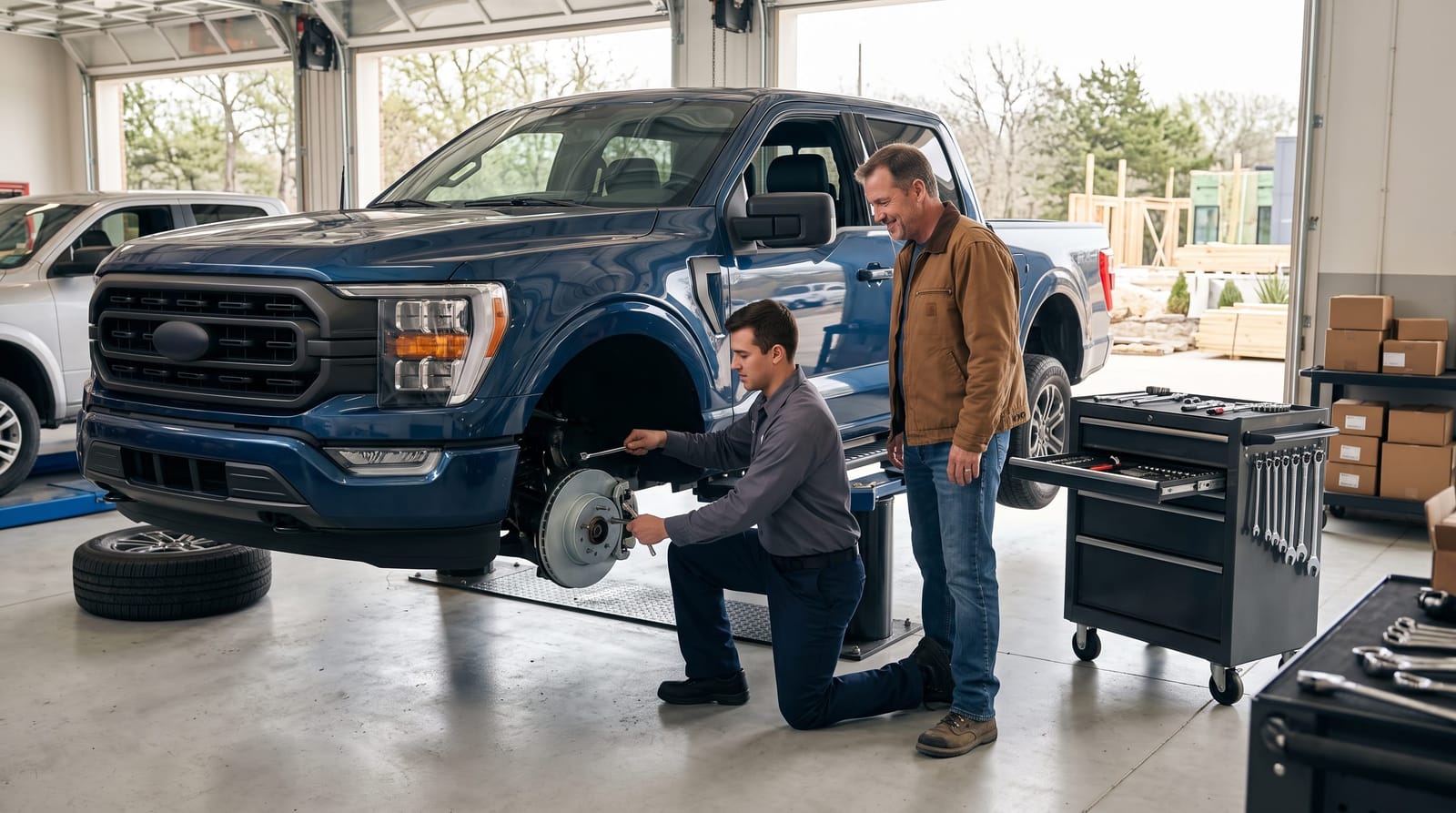
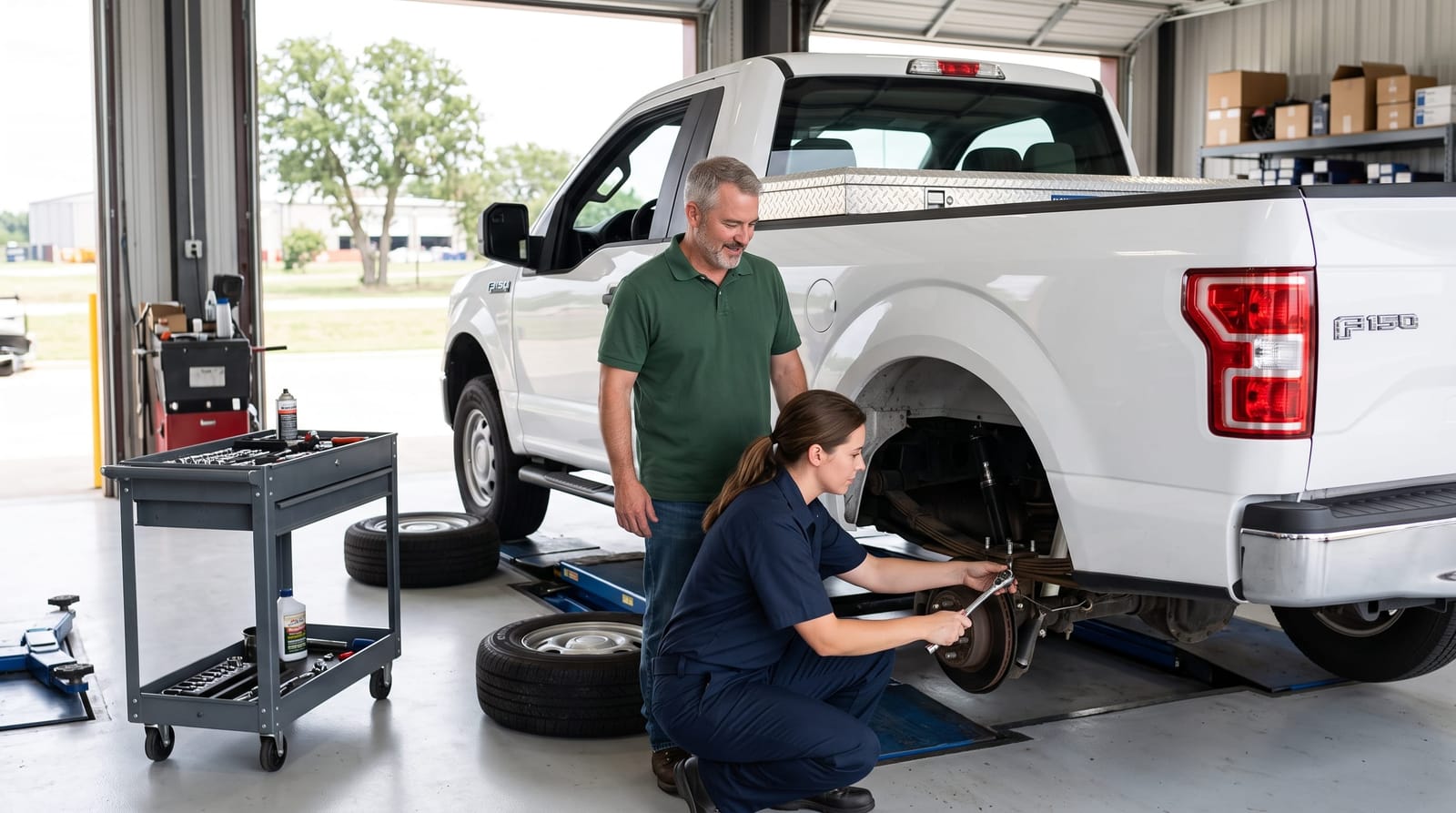
Brakes wear faster when you're regularly stopping a heavier combined vehicle weight, and that's especially true if your routes involve hills, frequent stops, or intersections where you're bringing a loaded trailer to a full stop from highway speed.
A loaded trailer can add anywhere from 5,000 to 15,000 pounds of rolling weight that your truck's brakes are helping to control. Even with a functioning trailer brake controller, your truck's brakes carry a meaningful share of that stopping responsibility. Brake pads on a truck used for regular towing can wear at roughly 1.5 to 2 times the rate compared to the same truck driven unloaded.
Rather than relying only on mileage intervals, it's worth having your brakes visually inspected at every oil change if you tow consistently. A technician can check pad thickness, rotor condition, and brake fluid moisture content in just a few minutes. Brake fluid absorbs moisture over time, which lowers its boiling point: something that matters more when your brakes are working hard on a hot day in East Texas.
For most towing trucks in this area, a thorough brake inspection every 10,000 to 15,000 miles is a reasonable baseline, with the understanding that your actual wear rate depends heavily on load, terrain, and frequency of use.
Coolant System Service: Keeping Your Engine Temperature Stable Under Load
Your truck's cooling system is doing double duty when you're towing in the summer: managing engine heat that's already elevated by the ambient temperature and the added mechanical load of pulling weight. A cooling system that's performing at 90% efficiency during a normal drive can be pushed to its limits when towing in 98°F heat through Crandall or Forney.
Coolant doesn't last forever. Over time, the additives in coolant that prevent corrosion and regulate pH break down, which can lead to minor internal corrosion in your radiator, water pump, and heater core. Most modern trucks use extended-life coolant that's rated for around 5 years or 150,000 miles under normal conditions, but a truck that tows regularly is not operating under normal conditions.
A good approach for towing trucks in East Texas is to have your coolant tested every 2 years, regardless of mileage. A simple test strip can tell a technician whether the protective additives are still effective or whether the system is ready for a flush and refill. You should also make a habit of checking your coolant level and looking for any signs of discoloration or oily residue, which can indicate a more serious issue worth addressing early.
If you've also noticed your truck shaking or vibrating while towing, that's a separate issue worth looking into: drivetrain and suspension problems can also affect how hard your cooling and braking systems have to work.
Building a Practical Service Schedule for Your Towing Truck
Rather than tracking three separate intervals for three different systems, the easiest approach is to use your oil change appointments as a natural checkpoint for everything else. Here's a simplified framework that works well for work trucks in Kaufman County:
- Every oil change: Visual brake inspection, tire pressure and wear check, fluid level review including coolant and transmission fluid
- Every 15,000 miles or annually: Brake pad measurement, transmission fluid condition check, coolant test
- Every 30,000 miles or as indicated: Transmission fluid change (adjust based on towing frequency and load), full cooling system inspection
- Every 2 years: Coolant flush and refill if testing indicates depleted additives, brake fluid replacement
This isn't a rigid checklist: it's a starting point. A good shop will look at how your specific truck is being used and recommend adjustments based on actual fluid condition and component wear rather than just mileage numbers.
Frequently Asked Questions
Does towing a lighter load still count as severe-duty driving?
Yes, if you're towing regularly, even at lighter weights, the combination of East Texas summer heat and added trailer load still puts more stress on your drivetrain and cooling system than unloaded driving does. The frequency of towing matters as much as the load weight.
How do I know if my transmission fluid needs to be changed before the mileage interval?
Healthy transmission fluid is typically red or pink and has a slightly sweet smell. Dark brown or black fluid with a burnt odor is a sign it's been stressed and needs attention. A shop can also check it with a test strip to measure its condition more accurately.
Should I change my oil more often if I tow a lot in the summer?
Possibly, yes. Most manufacturers recommend shorter oil change intervals under severe-duty conditions. If you're using conventional oil and towing regularly in summer heat, a 3,000 to 5,000 mile interval is reasonable. Full synthetic oil handles heat better and often allows slightly longer intervals, but your actual usage should guide the decision.
What's the most common issue that comes up on towing trucks that weren't properly maintained?
Transmission problems and overheating are the two issues we see most often in trucks that have been used hard without adequate fluid maintenance. Both are largely preventable with consistent service intervals and fluid inspections.
Keeping Your Truck Ready for the Work Ahead
Towing in East Texas puts real demands on your truck, and the summer heat in Kaufman County only adds to that. The good news is that staying ahead of the wear is straightforward when you know which systems to watch and how often to have them checked. Transmission fluid, brakes, and your cooling system are the three areas that benefit most from adjusted service intervals on a working tow truck. Building those check-ins into your regular maintenance routine is one of the most practical things you can do to keep your truck reliable for the long haul.