How Often Should You Change the Oil in a Work Truck?
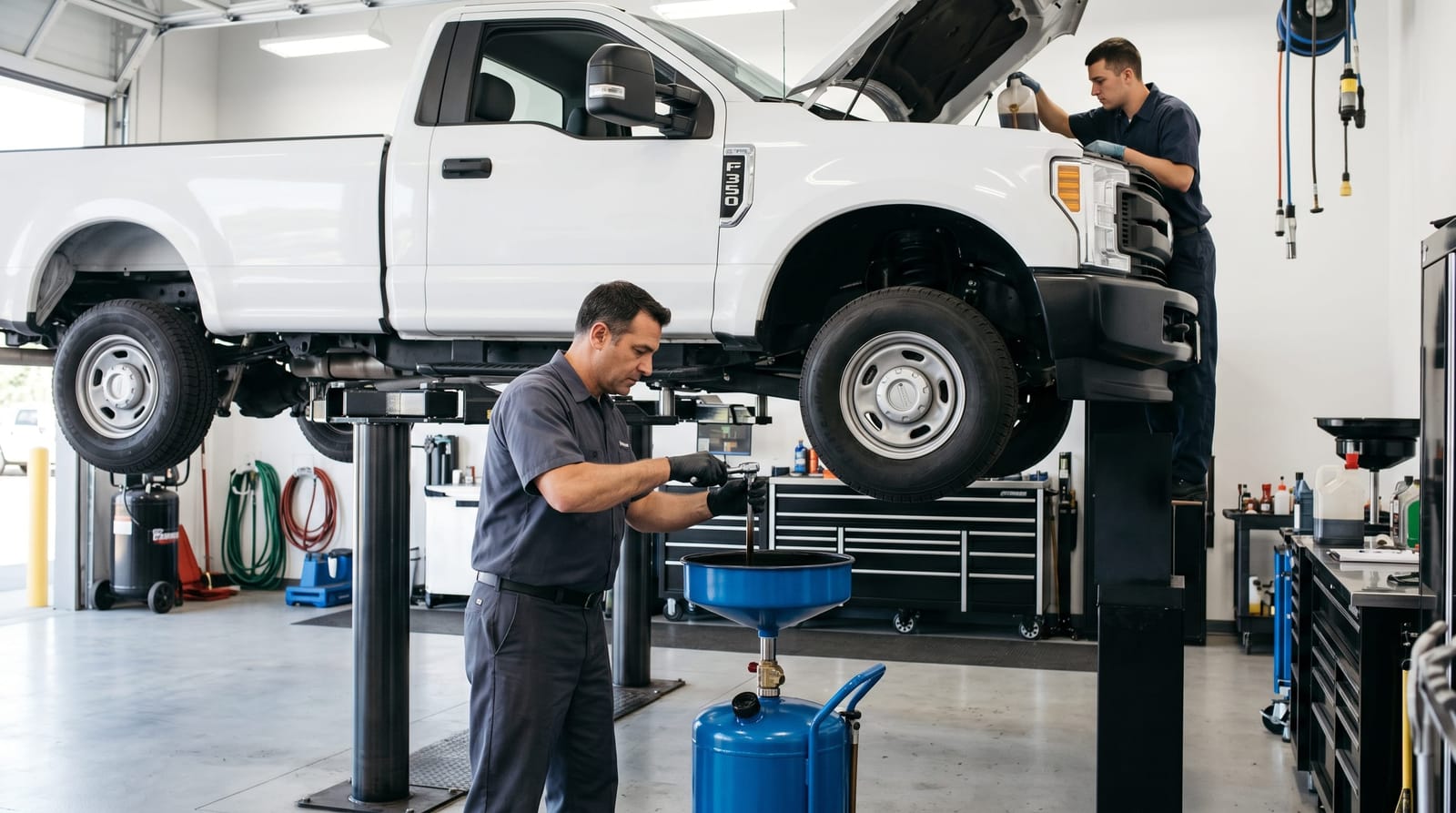
If you're running a work truck in Kaufman County, whether it's hauling tools to a job site in Forney, making deliveries across Terrell, or towing equipment out to Kaufman, that truck isn't living the easy life your owner's manual had in mind. The work truck oil change interval for commercial use is a different conversation than what applies to the average commuter vehicle. This post breaks down why commercial duty cycles shorten oil life, what intervals actually make sense for your situation, and how to build a simple routine that keeps your fleet moving without surprise breakdowns.
Why Commercial Use Changes Everything About Oil Life
Most people know that engine oil needs to be changed regularly, but the "why" behind it matters more when your truck is working hard every day. Engine oil does several important jobs at once: it lubricates moving metal parts, helps cool the engine, and carries away contaminants like dirt, metal particles, and combustion byproducts. The harder your engine works, the faster that oil gets used up and worn out.
Work trucks in commercial service face conditions that accelerate oil breakdown in ways that everyday passenger vehicles rarely encounter:
- Towing and hauling heavy loads, When your engine is pulling a trailer or carrying a full payload, it works harder and runs hotter. Higher heat breaks down oil faster than normal driving.
- Extended idling: Contractors and service technicians often leave their trucks running on job sites. Idling puts hours on the engine without adding miles to the odometer, which means your oil is degrading faster than your mileage suggests.
- Stop-and-go driving: Frequent stops and starts, common in urban delivery routes or neighborhood service work, prevent the engine from reaching its optimal temperature consistently, which can cause contaminants to build up in the oil more quickly.
- Dusty or dirty environments: Construction sites, gravel roads, and open fields in Kaufman County introduce more airborne particles into the engine environment, putting additional strain on the oil filter and the oil itself.
These aren't minor factors. They're the everyday reality for work trucks in commercial service, and they're exactly why the manufacturer's standard oil change interval may not apply to your situation.
What the Numbers Actually Look Like for Commercial Vehicles
Here's where it helps to look at some real figures. For commercial trucks in heavy-duty service, oil change intervals typically range from 10,000 to 50,000 miles depending on engine type, oil quality, and duty cycle, with 25,000 miles being a common general benchmark for fleet trucks using full synthetic oil under moderate commercial conditions. However, trucks operating under severe service conditions, consistent towing, heavy idling, or dusty worksites, should lean toward the shorter end of that range.
For many small business trucks in Kaufman County running conventional or mixed-use oil, a practical starting point is somewhere between 5,000 and 7,500 miles if you're not using a full synthetic. For trucks on full synthetic oil with moderate commercial use, 7,500 to 10,000 miles is a reasonable range. If your truck is pulling heavy loads daily or spending long stretches idling, shortening that interval to 5,000 miles is a conservative and sensible choice.
The key takeaway: a work truck that idles two hours a day, hauls a loaded trailer to job sites, and kicks up dust on gravel roads is not the same as the same model of truck driven on a highway for a commute. Treat them the same way and you're shortchanging the engine that your business depends on.
How to Set a Practical Oil Change Schedule for Your Work Trucks
One of the most common mistakes small business owners make is relying entirely on the odometer to trigger oil changes. Mileage alone doesn't capture the full story for commercial vehicles. A better approach combines mileage, time, and your truck's actual working conditions.
Here's a simple framework to work with:
- Start with your oil type. Know whether your trucks use conventional, synthetic blend, or full synthetic oil. Full synthetic holds up better under heat and stress, making it a worthwhile investment for trucks in demanding commercial service.
- Define your service category. Honest answer: are your trucks in light commercial use (occasional hauling, mostly highway miles) or severe commercial use (daily towing, heavy idling, dirty environments)? This determines whether you're on a 7,500-mile schedule or a 5,000-mile schedule.
- Track time, not just miles. A truck that sits and idles on a job site four hours a day might only log 1,000 miles a week but puts serious wear on the engine. Consider setting a maximum time interval, such as every 6 months regardless of mileage, as a backstop.
- Keep a simple maintenance log. For each truck in your fleet, note the date, mileage, and oil type at each change. This takes five minutes and pays off every time you need to make a service decision quickly.
If you're managing multiple trucks and trying to build a maintenance routine that doesn't interfere with your work schedule, scheduling maintenance around your business schedule to minimize downtime is worth thinking through carefully: staggering service appointments so you never have two trucks out at the same time can make a real difference in day-to-day operations.
What Happens When Oil Changes Are Delayed on Work Trucks
This isn't meant to alarm anyone: most trucks are more forgiving than people think. But it is worth understanding what actually happens when oil changes get pushed too far, especially under commercial conditions.
As engine oil ages and degrades, it loses its ability to lubricate effectively. It becomes thicker, develops sludge deposits, and carries more contaminants. For a work truck that's already running hotter and harder than average, degraded oil means more friction between moving parts, more heat buildup, and more wear over time. None of that happens overnight, but it does add up, and the repairs that result from years of neglected oil maintenance are almost always more costly than consistent oil changes would have been.
The goal isn't to create anxiety about every mile over the interval. It's to build a habit that's consistent enough to protect your investment without becoming a distraction from running your business.
Oil Analysis: A Smarter Option for Larger Fleets
If you're managing three or more vehicles, oil analysis is a tool worth knowing about. It involves sending a small sample of used engine oil to a lab that tests it for contamination levels, metal particles, and remaining lubricant quality. The results tell you exactly how much life is left in the oil, and whether your current change interval is too conservative, about right, or not frequent enough.
Fleet operators use oil analysis to fine-tune change intervals for each vehicle based on its actual duty cycle rather than guessing. Over time, this can reduce unnecessary oil changes on trucks that don't need them yet, while catching trucks that need more frequent service before problems develop. It's a practical, data-based approach that fits well with a small business mindset: spend money where it matters, save it where you can.
For smaller fleets of one or two trucks, the cost and logistics of formal oil analysis may not be worth it. In that case, the mileage-plus-time framework described above is a solid and reliable alternative.
Frequently Asked Questions
What is the recommended work truck oil change interval for commercial use?
For work trucks in commercial service, oil change intervals generally range from 5,000 to 10,000 miles depending on oil type and duty cycle. Full synthetic oil under moderate conditions can stretch toward the higher end, while trucks that tow regularly, idle frequently, or operate in dusty environments should aim for 5,000-mile intervals. Always consider time as a factor too: most shops recommend changing oil at least every 6 months regardless of mileage if the truck sees regular commercial use.
Does idling count toward an oil change interval?
Yes, and this is one of the most overlooked factors for work trucks. Engine idling puts wear on the engine and degrades oil without adding miles to the odometer. If your trucks idle significantly on job sites or in traffic, you should shorten your change interval accordingly and track service by time as well as mileage.
Is full synthetic oil worth it for work trucks?
For most commercial-use work trucks, full synthetic oil is a sound investment. It holds up better under high heat, performs more consistently in stop-and-go and towing conditions, and can support slightly longer change intervals than conventional oil. The upfront cost is higher per oil change, but synthetic oil's durability often makes it cost-effective over time for trucks in demanding service.
How do I know if my work truck is in "severe service" conditions?
Most vehicle manufacturers define severe service as conditions that include frequent towing or hauling, extended idling, stop-and-go driving in extreme temperatures, or operation in dusty or dirty environments. If your work truck regularly does any of these things, which describes most Kaufman County contractor and service vehicles, you should follow the severe service maintenance schedule, which typically means shorter oil change intervals and more frequent inspections.
Keeping Your Work Truck Ready for the Job
Understanding the right work truck oil change interval for commercial use comes down to one honest principle: your truck works harder than average, so its maintenance schedule should reflect that. Whether you're running a single service vehicle or managing a small fleet across Kaufman County, setting a consistent oil change schedule based on your actual duty cycle, not just the sticker on the windshield, is one of the most effective things you can do to extend the life of your vehicles and avoid costly downtime. Pair that with a solid daily inspection routine, as covered in how to inspect your work truck before sending it out each day, and you'll have the foundation of a maintenance program that actually works for your business. When you're ready to get your work trucks serviced, Gregg Automotive in Forney is here to help.